

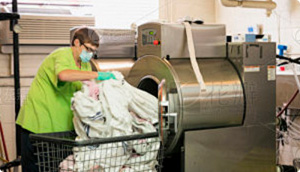
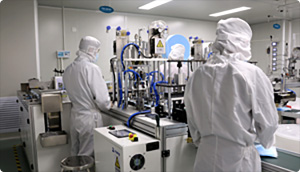
Did you know that the management costs and infection risks of the bed sheets, duvet covers, and surgical gowns circulating in a hospital far exceed imagination? Inaccurate counting, chaotic circulation, unidentified losses... These "invisible costs" are quietly devouring the hospital's efficiency and safety. It is time to use a pair of "smart eyes" to illuminate the entire process of fabric management.
In a hospital, which operates as a finely tuned organism, every link is crucial to life and health. We pay attention to sophisticated equipment and drug safety, yet we often overlook a silent but vital role—medical textiles.
These textiles, which come into intimate contact with patients and medical staff every day, directly impact the following in terms of management quality:
Infection control: One of the sources of cross-infection risk.
Cost control: Enormous costs for procurement, laundering, and replacement.
Operational efficiency: The time cost for clinical departments waiting for clean textiles.
Asset management: The "unclear accounts" of a large number of circulating assets.
The key to solving all these pain points lies in "full-process traceability."
Today, we will introduce the "golden partners" for achieving smart traceability: RFID tags and iron-on labels.
I. RFID Tags: The "Electronic ID Cards" of Textiles, Making Management Clear at a Glance
Imagine this: every bed sheet, work uniform, and scrub top... has a unique "electronic ID card." There is no need to open the packages; a simple scan with a handheld device puts all the information right at your fingertips. This is the transformation brought about by RFID technology.
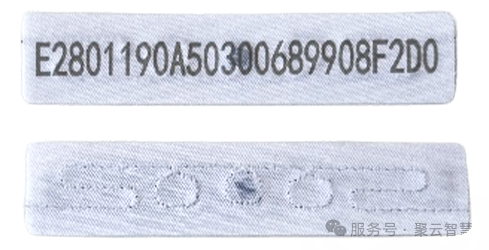
Core Value Brought by RFID Tags:
01. "Second-Level" Inventory Counting, Skyrocketing Efficiency
Say goodbye to: Manual piece-by-piece counting, which is time-consuming and error-prone.
Embrace: Second-level reading of whole packages and full carts, automatic data upload, and an inventory efficiency improvement of over 90%.
02. "Full-Chain" Visual Circulation, Accountability Down to Each Item
Closed-loop records from department → transport → laundry center → warehouse → department. Any backlog or loss at any stage is clear at a glance, providing precise data support for infection control traceability.
03. "Lifecycle" Management, Controllable Costs
The system automatically records the washing frequency of each textile item. This eliminates the infection control risks of "overdue service" and the asset waste of "premature scrapping."
04. "Intelligent" Inventory Alerts, Ensuring Supply
Real-time monitoring of textile inventory in each department. When levels fall below the safety line, administrators are prompted to replenish in time, ensuring that clinical needs are never interrupted.
II. Iron-on Labels: Creating a "Visual, Breathable" Identity for Medical Staff Uniforms
In smart hospital textile management, iron-on labels, with their unique advantages, are particularly suitable for medical staff uniforms that require frequent identification, are worn close to the skin, and are subject to strict management. They not only carry information but also integrate comfort, safety, and professional image, making them one of the standard features of modern hospital refined management.

Core Advantages of Iron-on Labels:
01. Clear and Intuitive Information, Achieving "One-Second Identification"
Key information such as names, departments, positions, and employee IDs can be ironed on, achieving "visualization" of personnel identities.
The laundry facility can also quickly sort items based on label information and accurately return them to the corresponding departments or individuals, enhancing circulation efficiency.
02. Skin-Friendly, Soft and Smooth, Redesigning the "Wearing Experience"
The label seamlessly integrates with the fabric, completely eliminating the friction, itching, and other discomforts caused by traditional sewn-in labels.
It is especially suitable for medical staff who wear uniforms for long periods, reflecting the hospital's humanized care for its employees through attention to detail.
03. Resistance to Rigorous Washing and Disinfection, Ensuring "Long-Lasting Durability"
Specifically designed for medical environments, it withstands high-temperature washing and repeated treatment with strong disinfectants.
The text and patterns remain clear for a long time and are resistant to peeling and wear, ensuring that information is not lost throughout the entire service life.
04. Seamless and Smooth Surface, Meeting "Infection Control Requirements"
The overall surface is flat and seamless, preventing dirt and bacteria from accumulating, and complies with hospital infection control standards.
Compared with stitched labels, it is easier to clean and disinfect, reducing the risk of cross-infection.
05. Unified Professional Image, Conveying "Brand Culture"
A uniform and standardized identification system strengthens the hospital's professional image and management standards, conveying hospital culture through details.
III. The Perfect Combination of Dual Tags: Building a New Ecosystem for Smart Textile Management
RFID tags and iron-on labels are not a substitute for each other, but rather a "golden partnership" with complementary functions.
Best Practice Model:
On medical staff uniforms: Embed a concealed RFID tag (e.g., sewn inside the lower hem) for global asset traceability and lifecycle management; at the same time, iron on a visual label containing personal information at designated locations such as the inside of the collar for daily identification and sorting.
On patient linens: Embed RFID tags for full-process traceability.
Ultimately, this system achieves the following:
· For Administrators: Complete clarity on all textiles, reducing costs and increasing efficiency in management.
· For the Infection Control Department: Full-process traceability during circulation, building a solid safety barrier.
· For Clinical Staff: Comfortable and presentable uniforms, with fast and accurate pickup.