
On a laundry plant's cost sheet, the most expensive line is often not written under water, electricity, or gas, but after the four words "unplanned downtime."
When a tunnel washer stops for two hours, the presses, through-feed dryers, and finishing equipment behind it are all waiting; when a bearing seizes, it often takes the shaft and the motor with it. The money actually paid out is for the time spent down, and for the entire production line that is forced into disarray.
Traditional approaches offer only two moves: scheduled maintenance — tear it down when the time comes, good or bad; and breakdown repair — wait until it stops, then find someone.
The former often tears down good equipment; the latter relies on luck. The blank space in between is where equipment management is truly difficult.
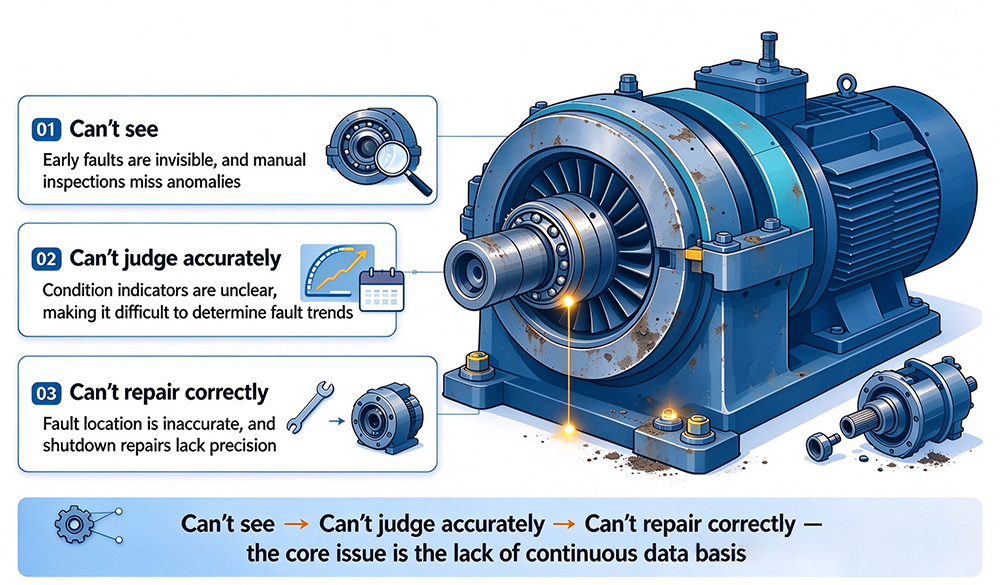
Equipment Management Is Stuck on Three Blanks
01、Can't see it
Bearing outer-ring spalling, impeller lint accumulation and scaling, anchor mechanical looseness — these forms of degradation produce no abnormal noise, no odor, and no alarm in the early stages, and cannot be found by manual inspection.
02、Can't say for sure
You vaguely know that a piece of equipment is "not in great shape," but you don't know how many days it has left, whether it can last until the next maintenance window, or whether spare parts should be ordered now.
03、Can't fix the right thing
You only know where the problem is after taking it apart, and after taking it apart you find it wasn't there — a wasted shutdown, a wasted crew, and the fault is still where it was.
What the System Does Is Actually Four Things
Multi-parameter online collection of vibration, temperature, and current first makes equipment status "visible," then translates it into usable judgments.
One: Make status visible
Vibration / temperature / current and other multi-parameters online, equipment status visible in real time. No reliance on inspection rounds, no reliance on listening for sounds.
→ Night shifts and weekend shifts — the equipment still has someone watching it.
Two: Alarm before failure
Identify early features such as bearing outer-ring faults, mechanical looseness, and misalignment — not waiting to report until there is abnormal noise.
→ When the alarm comes, you can still schedule production, rather than the alarm coming when it has already stopped.
Three: Calculate how many days are left
Remaining useful life (RUL) is given in days, so when to order spare parts and which weekend to schedule the next planned downtime can be decided in advance.
→ No need to stop the whole line for a week just to wait for one bearing.
Four: Repair by condition, not by calendar
Alarms automatically generate work orders; equipment in good condition is left alone.
→ What is saved is not just repair costs, but also disassembly labor hours and the secondary risks that repeated disassembly itself brings.
Why This System Is Different
There are many PHM players on the market; the difference is not in the feature list, but in these two places:
· The criteria come from the laundry floor, not from a generic manual
Tunnel washer bearing outer-ring spalling, press impeller lint accumulation and scaling, anchor mechanical looseness — these forms of degradation don't look like this in generic models.
Lint accumulation and scaling is a slowly climbing load, not a jump; using fixed thresholds to catch it means either no alarm at all, or false alarms every day, and eventually the site just turns the system off.
→ The criteria are written according to laundry degradation paths — this is the most fundamental difference from "buying a generic PHM and installing it."
· Give the site one conclusion, not a pile of spectra
Time-domain waveforms show overall impact, FFT spectra show characteristic frequencies, and envelope spectra dig out early bearing defects — these are for the algorithm.
What is shown to the site is one sentence: "The front bearing of this press has early spalling; recommend handling within 15 days."
→ If the shift leader can't understand it, they won't open it — whether this layer of translation is done determines whether this thing gets used or gets put on a shelf.
One System: First the Whole Line, Then the Single Machine
These are two pages within the same system. Managers first judge "which machine most needs attention" on the whole-line overview page, then click into the equipment and go to the single-machine diagnosis page to see "what exactly is wrong with this one."
▍Whole-line overview page: first see clearly who is degrading
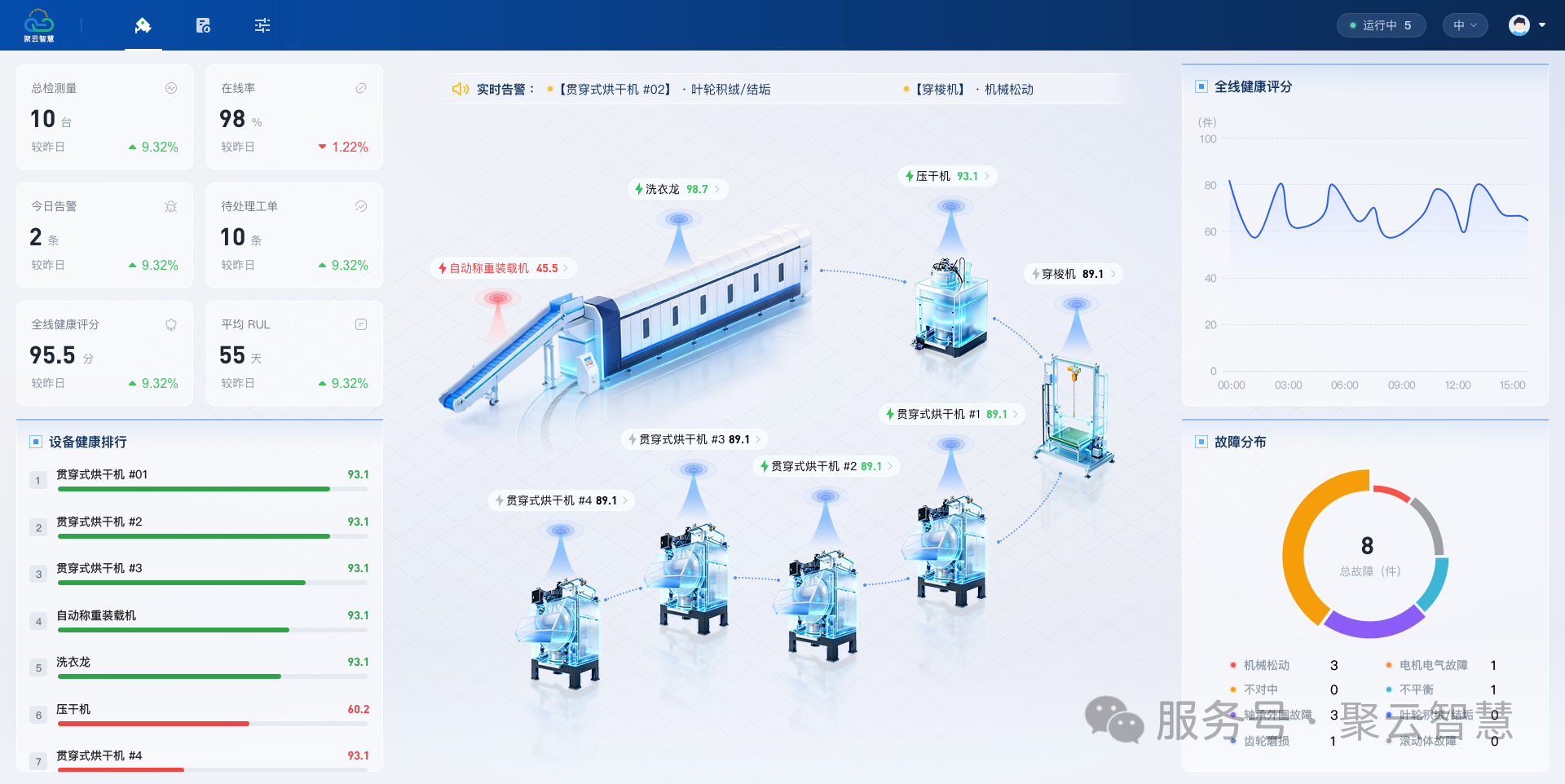
Washing Equipment PHM-CBM Intelligent Monitoring System
On the left are six key indicators: number of equipment under inspection, online rate, today's alarms, pending work orders, whole-line health score, and average remaining life; in the middle are real-time alarm locations arranged by production line; below is a ranking by health score — the one marked in red can be picked out at a glance.
▍Single-machine diagnosis page: where it's broken, and how badly
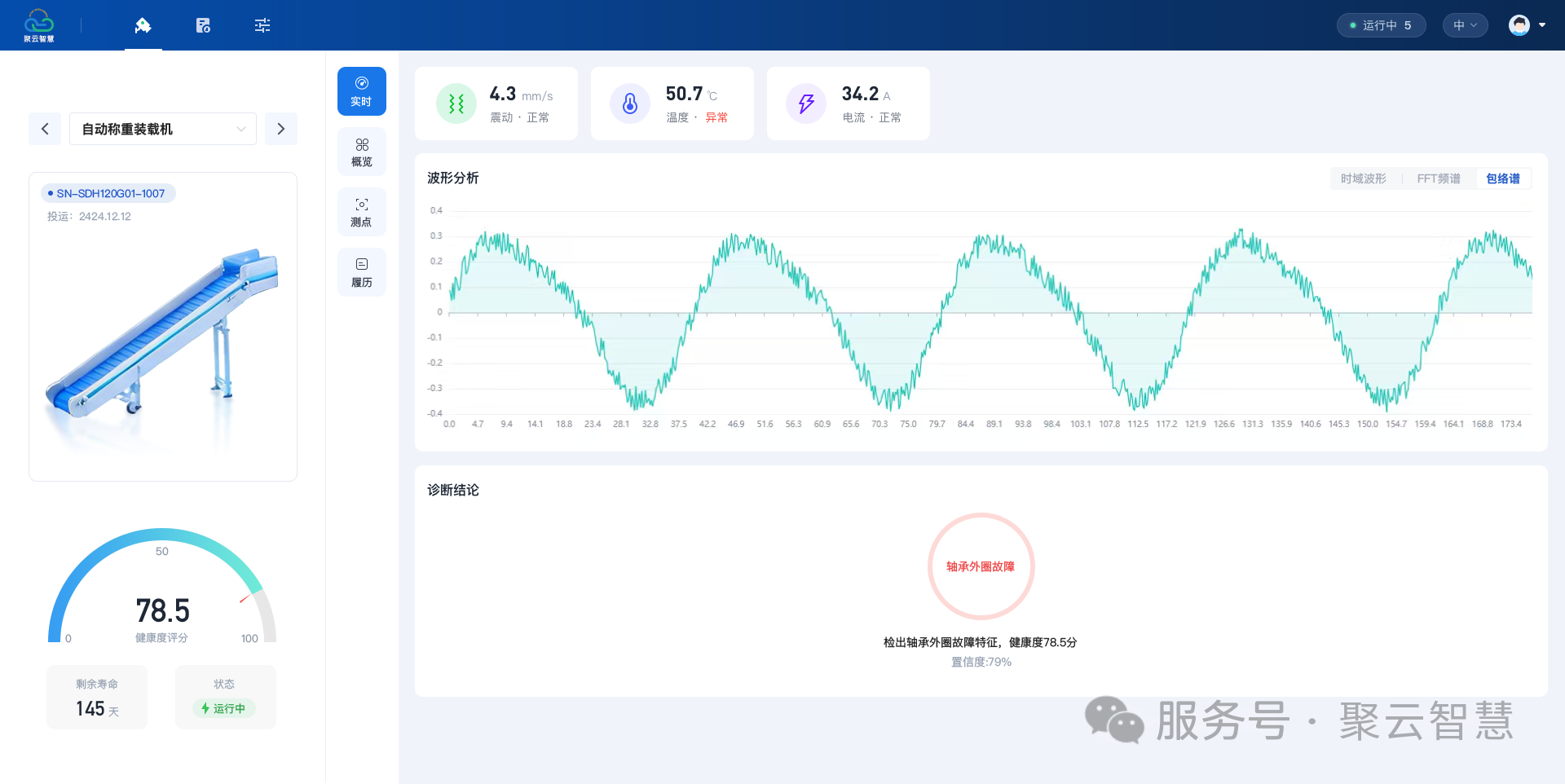
Washing Equipment PHM-CBM Intelligent Monitoring System
Click into any piece of equipment and you see the various parameters, spectra, and one conclusion: time-domain waveforms show overall impact, FFT spectra show characteristic frequencies, and envelope spectra dig out early bearing defects — the former for the algorithm, the latter for the site.
The equipment is still running, and the work order can already be scheduled. When to replace the bearing, which weekend to schedule the next planned downtime — it's all decided before it stops.
From "scheduled repair" to "condition-based repair"
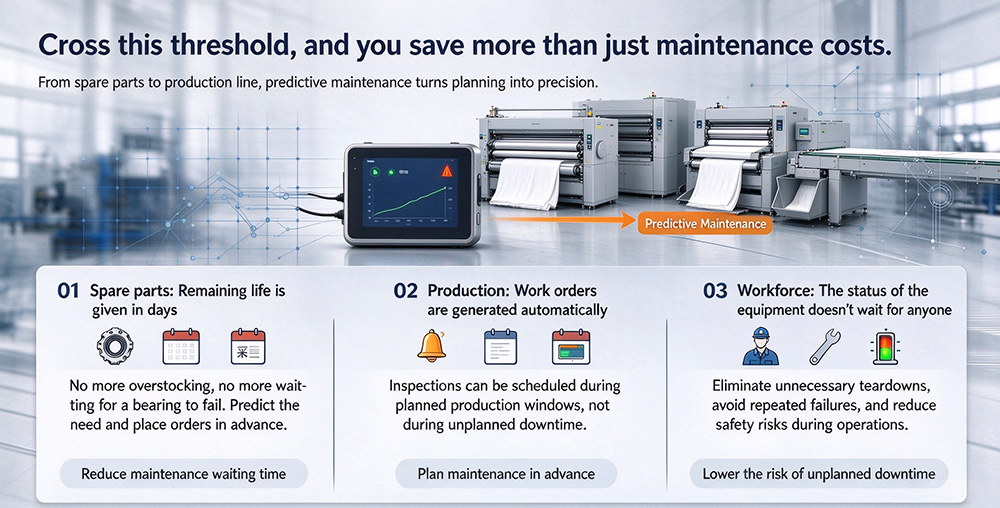
Once you cross this step, what you save is not just repair costs.
- Spare parts: Remaining life is given in days, so procurement doesn't have to gamble, and doesn't have to stop the whole line for a week waiting for one bearing.
- Production scheduling: Alarms automatically generate work orders, so maintenance can be scheduled into windows that were already going to be down, rather than being forced to stop while rushing orders.
- Labor: Equipment in good condition is left alone, saving disassembly labor hours as well as the risks that repeated disassembly itself brings.
The next step in equipment management is not repairing faster — it's making the one repair that's needed come at exactly the right time.
#LaundryPlantIntelligentUpgrade #SmartLaundryFactory #CostReductionAndEfficiencyImprovement #PHMIntelligentMonitoring #LaundryFinishing